
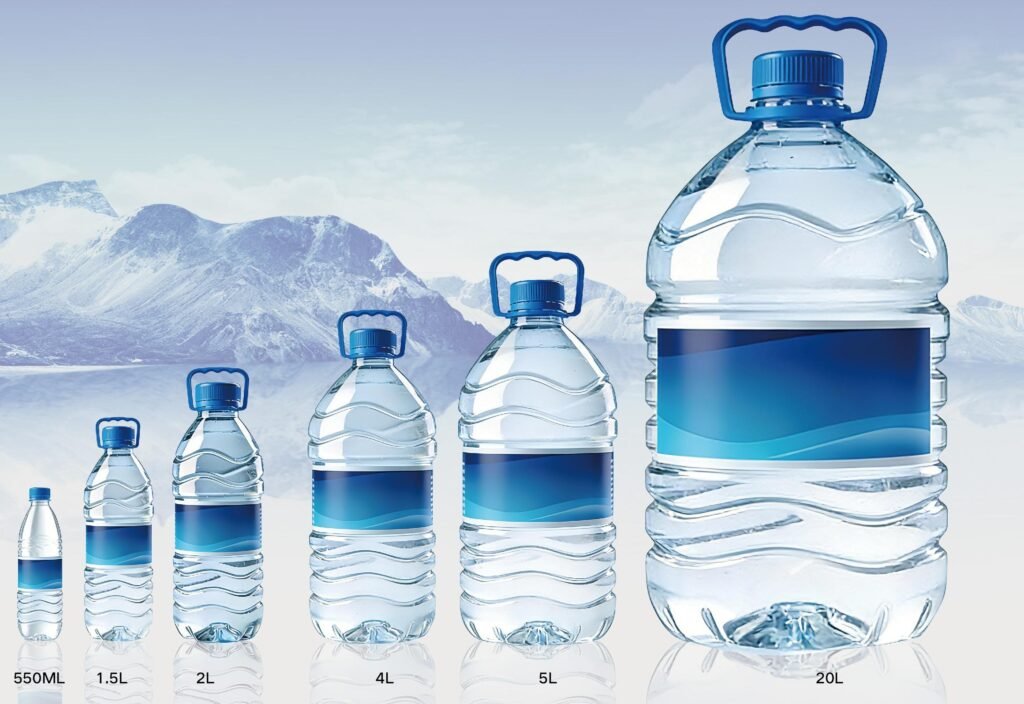
Large Bottle / 5 Gallon Blowing Machines
High-Speed PET Bottle Blow Molding Machine (2.5–20L)
The DEXIN large-bottle PET blow molding machine is a fully automatic, all-servo linear stretch blow molder for 2.5–20 L bottles, including disposable 5-gallon water barrels. Nine models with 1 to 6 cavities make 600–6,000 bottles per hour for bottled water, edible oil and daily chemicals.
- 1–6
- Cavities
- 2.5–20L
- Bottle size
- 6,000BPH
- Max. output
- 33%
- Less high-pressure air
Overview
The DEXIN large-bottle blow molding machine makes PET bottles from 2.5 L to 20 L, including 18.9 L (5-gallon) disposable water barrels, edible oil jugs and large daily chemical containers. It is a linear, fully automatic stretch blow molder: preforms are loaded, heated, moved by a servo-driven variable-pitch mechanism and blown into bottles in one continuous cycle.
Nine models cover two size ranges. The 7 L models (L2-5L, L3-5L, L4-5, L6-5L) have 2 to 6 cavities and make 2,400–6,000 bottles per hour on 5 L bottles. The G and GE models (L1G, L1GE, L2G, L2GE, L3GE) have 1 to 3 cavities, make 600–2,000 bottles per hour and take bottles up to 20 L, 290 mm in diameter and 500 mm high.
The machine is built for disposable (one-way) PET barrels. It is not designed for heavy returnable PC or thick-wall PET 5-gallon bottles.
Lower running cost
Compressed air is the largest running cost in blow molding. An integrated sealed valve block cuts high-pressure air consumption by about 33% compared with conventional linear machines, and a separate high-pressure air circuit reduces valve wear, lowering maintenance cost by up to 90%.
Stable output in any plant
Constant-voltage heating keeps preform temperature steady when the local grid fluctuates, and every heating lamp is monitored, so a failed lamp raises an alarm before it produces rejects. The machine is controlled by a Siemens PLC with a touch-screen HMI that logs production data and diagnoses faults.
Key features
Why this machine uses less air and power
-
Integrated sealed valve block
Four high-pressure valves combined in one sealed block shorten the air path and cut high-pressure air consumption by about 33%.
-
High-pressure air separation
US-made high-speed high-pressure solenoid valves on a separate air circuit wear less, lowering maintenance cost by up to 90%.
-
Full servo drive with linkage
Servo motors combined with a linkage mechanism give fast, repeatable motion at high speed with low energy use.
-
Constant-voltage heating
Heating output stays stable when the grid voltage fluctuates, so bottle wall thickness stays consistent.
-
Heating lamp failure alarm
Each lamp is monitored; a failed lamp raises an alarm at once, reducing rejects and raising the pass rate.
-
Up to 1,000 BPH per cavity
High output per cavity on large bottles means fewer cavities, a shorter machine and less floor space for the same output.
How it works
From preform to finished bottle
-
Preform loading
The automatic loader feeds and orients preforms into the machine.
-
Infrared heating
Preforms rotate through the constant-voltage oven to an even blowing temperature.
-
Variable-pitch transfer
The servo variable-pitch mechanism spaces the hot preforms to the mould pitch.
-
Stretch blowing
The mould closes, the stretch rod extends and 3.4 MPa air forms the bottle.
-
Bottle discharge
Finished bottles leave on the air conveyor, ready for filling.
Technical specifications
Compare 9 models
| Model | L2-5L | L3-5L | L4-5 | L6-5L | L1G | L1GE | L2G | L2GE | L3GE |
|---|---|---|---|---|---|---|---|---|---|
| Cavities | 2 | 3 | 4 | 6 | 1 | 1 | 2 | 2 | 3 |
| Output BPH | 2,4005 L bottle | 3,3005 L bottle | 4,0005 L bottle | 6,0005 L bottle | 6005–20 L bottle | 9005–20 L bottle | 1,2005–20 L bottle | 1,5005–20 L bottle | 2,0005–20 L bottle |
| Bottle volume L | 2.5–7 | 2.5–7 | 2.5–7 | 2.5–7 | 2.5–20 | 2.5–20 | 2.5–20 | 2.5–20 | 2.5–20 |
| Neck inner diameter mm | 30–50 | 50 | 30–50 | 30–50 | 45–55 | 45–55 | 45–55 | 45–55 | 45–55 |
| Max. bottle diameter mm | 185 | 185 | 185 | 185 | 290 | 290 | 290 | 290 | 290 |
| Max. bottle height mm | 350 | 350 | 350 | 350 | 500 | 500 | 500 | 500 | 500 |
| Total installed power kW | 60 | 70 | 80 | 90 | 60 | 60 | 90 | 90 | 120 |
| Blowing air pressure MPa | 3.4 | 3.4 | 3.4 | 3.4 | 3.4 | 3.4 | 3.4 | 3.4 | 3.4 |
| High-pressure air consumption m³/min | 6 | 9.5 | 12 | 15 | 6 | 8 | 12 | 16 | 20 |
| Dimensions (L × W × H) mm | 5000 × 2200 × 2700 | 6000 × 2200 × 2700 | 8000 × 2200 × 2700 | 10000 × 2200 × 2700 | 5000 × 2200 × 2700 | 5000 × 2200 × 2700 | 6000 × 2200 × 2700 | 6000 × 2200 × 2700 | 8000 × 2200 × 2700 |
| Weight kg | 5,000 | 6,000 | 8,000 | 9,000 | 6,000 | 6,000 | 7,000 | 7,000 | 9,000 |
Output is theoretical and depends on bottle weight and shape; figures are for the reference bottle shown under each number. Scroll the table sideways on a phone.
Main configuration
| Component | Brand | Origin |
|---|---|---|
| PLC and touch-screen HMI | Siemens | Germany |
| High-speed high-pressure solenoid valves | — | USA |
Sample bottles
Bottles made on this machine
FAQ
Questions buyers ask
Not answered here? An engineer will reply on WhatsApp or email.
What bottle sizes can this machine make?
PET bottles from 2.5 L to 20 L. The 7 L models (L2-5L, L3-5L, L4-5, L6-5L) take bottles up to 7 L, 185 mm in diameter and 350 mm high; the G and GE models (L1G, L1GE, L2G, L2GE, L3GE) take bottles up to 20 L, 290 mm in diameter and 500 mm high.
Can it make 5-gallon water barrels?
Yes. The G and GE models blow disposable (one-way) 18.9 L PET barrels for bottled water. The machine is not designed for heavy returnable PC or thick-wall PET 5-gallon bottles.
How many cavities do I need?
On 5 L bottles each cavity makes about 1,000–1,200 bottles per hour: 2,400 BPH needs 2 cavities (L2-5L) and 6,000 BPH needs 6 (L6-5L). For bottles up to 20 L, output runs from 600 BPH on the single-cavity L1G to 2,000 BPH on the 3-cavity L3GE. Send us your bottle drawing and preform weight and we will confirm the model.
How long does a mould change take?
In one 5–18.9 L disposable barrel water plant running an L2GE, mould change time was cut to 40 minutes, so one machine can switch bottle sizes within a shift.
What utilities does the machine need?
High-pressure air at 3.4 MPa (35 kg/cm²), chilled water at 10–12 °C for the moulds, cooling water at 30 °C and 2–4 kg/cm², and an electrical supply for 60–120 kW of installed power, depending on the model.
Which control system and key components do you use?
A Siemens PLC with a touch-screen HMI, a full servo drive, and US-made high-speed high-pressure solenoid valves.
Get a quote
Get a quote for the High-Speed PET Bottle Blow Molding Machine
Tell us your bottle size, bottle weight and target output. An engineer replies with the right model, a layout and a price, usually within one working day.